Thursday, 7 January 2021

BBN3402SATU2020: MINGGU TERJEMAHAN VIDEO(7)


M11 - TERJEMAHAN VIDEO (7)


7. Sorotan Kajian (Bab 2) #JomTulisTesis


Bab 2 ya sorotan kajian. Dalam sorotan kajian, 2.1 pengenalan. Seperti biasa dalam pengenalan kita nak huraikan apa ada dalam bab ini. Kita jelaskan juga dalam bab ini juga terdiri daripada 2 subtopik yang berkaitan. Pastikan subtopik itu berkaitan dengan tajuk kita. Jadi, dicadangkan kalau biasanya Master, Bacelor dan Diploma kita boleh ada 2 subtopik sebab terpulang berapa pemboleh ubah tiap-tiap tajuk itu. Kemudian, PhD kadang-kadang ada 3 subtopik ataupun 2. Kita tengok juga apa pemboleh ubah dalam subtopik ini. Contohnya 2.2 ini, kajian tentang, kita ambil yang besar atau menyeluruh dahulu. Mungkin kita ambil kajian tentang wacana sahaja. Jadi kajian tentang wacana ini kita letak dalam ini kajian-kajian, pastinya satu kajian yang 5 tahun kebelakang. Ini sahaja dah jelaskan banyak kali bahawa 5 tahun kebelakang maknanya tahun yang awak hantar tesis tolak belakang 5 tahun, bukan tahun awak daftar. Kalau kita daftar 2020, kemudian awak nak tolak pula dengan 5 tahun kebelakang ini dah salah. Maknanya jangkaan awak nak hantar tesis, 2023 mungkin. Jadi kalau awak hantar tesis 2023, maknanya sorotan kajian tentulah 5 tahun kebelakang yang terakhir 2019. Jadi dalam ini mesti 5 tahun terkini. Jadi sebagai pelajar, awak tidak boleh katakan tiada kajian yang saya jumpa. Semua kajian ada walaupun paling hampir sikit-sikit pun boleh. Pastikan ambil 1 kajian yang menyerlah tentang wacana bermakna awak huraikan tentang kajian tersebut kemudian sokong. Jadi dalam sorotan kajian ini perlu cari persamaan dan perbezaan. Itulah kritis dalam sorotan kajian. Ada pelajar yang tulis 2, 3 halaman contohnya kajian Normaliza Abd Rahim (2019), dia letak 2,3 halaman semua nama Normaliza sampai tidak ada rujukan langsung, jadi itu salah dan tidak kritis. Seterusnya, awak boleh menjurus kepada kajian tentang animasi. Jadi secara menyeluruhnya animasi dari segi macam mana?. Contoh, animasi dari segi skrip sahaja ke, animasi cerita biasa ke, cerita rakyat biasa ke semua masuk disini dan ambil 5 tahun terkini. Dan kita kalau buat sorotan kajian bukan hanya Malaysia sahaja, barat pun perlu diambil, Jepun, Korea, China, semua kita perlu ambil supaya sorotan meluas. Terutamanya animasi ini memanglah ada banyak kajian dari Jepun yang paling terkenal dengan animasi, huraikan pastikan kritis. Kemudian, jurang penyelidikan. Jurang penyelidikan pastikan bahawa jelaskan apa jurang yang ada dalam ini yang berkaitan dengan kajian awak sendiri. Kajian ini berfokus kepada contohnya bla bla... Jadi kajian itu awak senaraikan yang ada dalam kajian ini. Ada jurang dalam kajian tersebut. Itu bermakna bila kita nak jelaskan jurang itu, senarai nama dalam ini kaitkan balik dengan kajian kita. Serupa juga dengan nombor 2, senarai itu apa jurang dan persamaan dengan perbezaan dan kaitkan dengan kajian awak sendiri. 2.5 kesimpulan, jadi kita kena pastikan rujukan 5 tahun kebelakang. No.2 tulisan dalam sorotan kajian perlu mencari persamaan dan perbezaan iaitu kritis. Hampir sama, berbeza, tidak bersetuju. Jadi cari perkataan yang bersesuai, ada banyak. Penyusunan ayat itu menunjukkan sama ada ia persamaan atau perbezaan. Di sini juga memerlukan penanda wacana, sangat penting kalau  tidak penulisan awak seperti karangan biasa tanpa penanda wacana. Ini harus kita lihat sebagai perkara penting. 5 tahun kebelakang, persamaan dan perbezaan penulisan secara kritis, mempunyai penanda wacana dan juga jurang penyelidikan penyelidikan perlu ada dalam satu subtopik iaitu kaitan kajian dalam sorotan kajian ini dengan awak sendiri. Jadi, seperti biasa kesimpulan itu kita simpulkan seperti bab-bab yang lain, ayat akhir dalam kesimpulan haruslah letak bab-bab seterusnya iaitu bab 3 bla bla... Jadi untuk halaman pelajar Bacelor, Diploma dan Master biasanya sama iaitu 2.2, 2.3 kita letak 15 halaman. Untuk PhD banyak kajian secara mendalam untuk 2.2, 2.3 30 halaman kalau kurang pun 25 halaman. Kalau kurang sorotan, nampak pelajar tak membaca. Tujuan sorotan untuk kita dapat lihat perbezaan kajian yang ada dan mencari jurang penyelidikan tersebut dan kita kaitkan dengan  kajian kita. Sangat perlu dan penting memerlukan jumlah halaman yang bersesuai. Ada juga pelajar Phd dan Master ada sorotan 14 halaman sahaja. Kemudian, pelajar Phd buat 25 halaman sahaja dan tidak bersesuaian dengan kajiannya. Semua bab-bab penting, jangan terlalu sedikit sehingga tidak dapat mencari jurang penyelidikan, bagaimana kita menulis, ada persamaan tak, ada perbezaan tak, adakah penulisan awak kritis, adakah awak menggunakan penanda wacana yang bersesuaian, adakah awak sorot kajian 5 tahun kebelakang. Ini semua penting dalam sorotan kajian.


 TERJEMAHAN BAHASA INGGERIS


7. Literature Review (Chapter 2) #LetsWriteAThesis


Chapter 2 is the focus of the literature review. In the literature review, 2.1 is introduction. As usual in the introduction we want to describe what is in this chapter. We explain also in this chapter also consists of 2 related subtopics. Make sure the subtopic is relevant to our topic. So, it is suggested that usually our Master, Bachelor and Diploma can have 2 subtopics because it depends on how many variables each title is. Then, PhD sometimes has 3 subtopics or 2. We also look at what variables are in this subtopic. For example 2.2 this, the study of, we take large or comprehensive first. Maybe we take the study of discourse only. So the study of this discourse we put in these studies, is definitely a study that 5 years ago. This alone has explained many times that the last 5 years means the year you submit your thesis minus 5 years, not the year you registered. If we register 2020, then you want to minus it with the last 5 years is wrong, your expectations to submit a thesis in 2023 maybe. So if you submit a thesis 2023, it means that the highlight of the study must be the last 5 years of 2019. So in this must be the latest 5 years. So as a student, you cannot say no study I found. All studies are available, even the smallest ones are possible. Make sure to take 1 study that stands out about the discourse means you describe the study then support. So in the highlights of this study it is necessary to look for similarities and differences. That is critical in the literature review. There are students who write 2, 3 pages for example Normaliza Abd Rahim (2019) study, he placed 2.3 pages of all Normaliza names until there is no direct reference, so it is wrong and not critical. Next, you can lead to the study of animation. So overall animation in terms of what kind?. For example, animation in terms of script only, animation of ordinary stories to, ordinary folk tales to all come in here and take the last 5 years. And if we do research highlights not only Malaysia, the west also needs to be taken, Japan, Korea, China, we all need to take so that the highlights are wide. Especially this animation of course there are many studies from Japan that are best known for animation, describe makesure it critical. Then, the research gap. Research gaps make sure that explain what gaps are in this related to your own research. This study focuses on for example blah blah ... So you list that study in this study. There is a gap in the study. That means when we want to explain the gap, the list of names in this is linked back to our study. Similar to number 2, the list is what gaps and similarities are with the differences and relate to your own study. 2.5 is conclusion, so we have to make sure the reference 5 years ago. No.2 writing in the study highlights need to find similarities and differences that are critical. Almost the same, different, disagree. So find the right word, there are many. The sentence structure shows whether it is a similarity or a difference. Here you also need discourse markers, it is very important if your writing is not like a regular essay without discourse markers. This we should see as important. The last 5 years, the similarities and differences of critical writing, having discourse markers as well as research gaps should be in one subtopic that is the relevance of the study in the highlights of your study. So, as usual we conclude the conclusion like the other chapters, the last sentence in the conclusion should be the next chapters which are chapter 3 bla bla ... So for the pages of Bachelor, Diploma and Master student are usually the same that is 2.2, 2.3 we put 15 pages. For PhD, a lot of depth study for 2.2, 2.3 30 pages if less than 25 pages. If there are slightly highlights, it seems that students do not read. The purpose of the highlight is for us to be able to see the differences of existing studies and find the research gap and we relate to our study. It is very necessary and important to require the appropriate number of pages. There are also Phd and Master students with 14 page highlights only. Later, Phd students made only 25 pages and did not fit into their study. All the important chapters, do not be too small so as not to find the research gap, how we write, there are no similarities, there are no differences, is your writing critical, do you use appropriate discourse markers, did you highlight the study 5 years ago. These are all important in the literature review.


RUJUKAN

Pautan video: https://www.youtube.com/watch?v=EQSL1RPfhtk


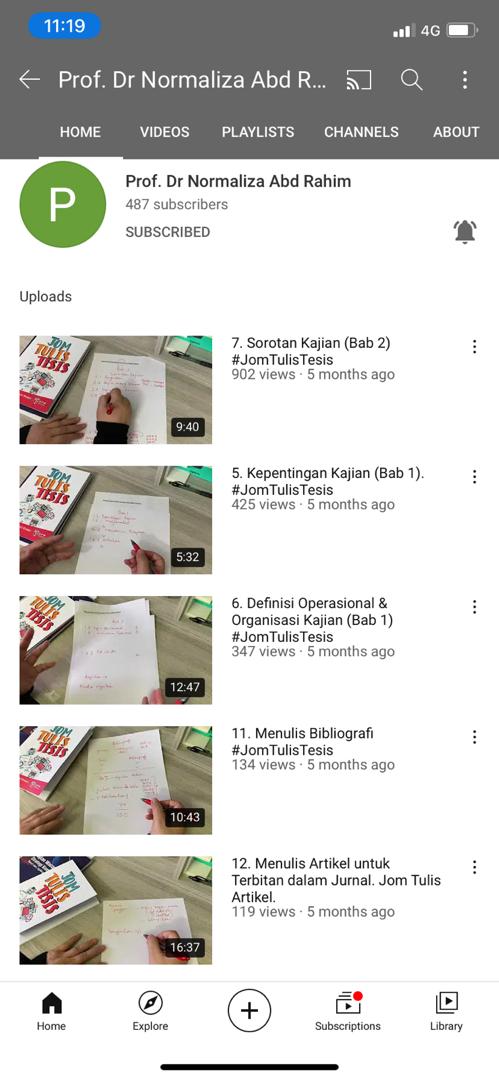
SAYA SUDAH SUBSCRIBE !!


BUKTI KEHADIRAN MINGGU 11


BBN3402SATU2020: MINGGU TERJEMAHAN VIDEO(6)


M11 - TERJEMAHAN VIDEO (6)


6. Definisi Operasional & Organisasi Kajian (bab 1) # JomTulisTesis


Bab 1 seterusnya, kita pergi 1.8 iaitu definisi operasional. Ok ini agak sukar ye, kadang-kadang pelajar ni dia agak keliru. Operasional bermakna tentang definisi kajian yang kita jalankan. Bukan definisi konsep, bukanlah definisi macam contoh pelajar buat, apa makna wacana, 1. Apa makna skrip 1, tekstual 1, animasi 1, cerita 1, rakyat 1, Melayu 1. Itu salah ya, kita bukan nak definisi itu. Kalau definisi tiap-tiap satu, pelajar akan rujuk kamus dewan sahaja dan semua jenis kamus. Jangan! Jadi operasional ialah tentang kajian kita. Biasanya definisi operasional ini minimum 2 dan paling maksimum 3, tentang bagaimana kita nak jalankan kajian ini supaya bila pembaca baca baru faham , ohh ini maksud dia. Jadi kalau kita tengok tajuk ini, kita boleh ambil 1 wacana tekstual, lagi 1 skrip animasi cerita rakyat Melayu. Kalau kita nak ambil bezakan skrip animasi tiada kaitan pula. Jadi kita boleh teruskan, untuk tajuk ini mungkin ada dua. Tajuk yang lain mungkin ada tiga. Kalau kita ambil tajuk daripada kejuruteraan contohnya, mungkin operasional ada banyak sebab banyak pemboleh ubahnya. Kalau daripada tesis Sains pun begitu, ada banyak pemboleh ubah yang membolehkan kita membuat definisi operasional supaya pemeriksa faham apa kaitan itu dengan tesis tersebut. Kalau kita tengok tesis dalam bentuk ekonomi juga begitu. Ada banyak  pemboleh ubah, mungkin lebih dari 3. Jadi untuk yang ini, kita fokus kepada 2, awak boleh buat begini kemudian letak contohnya, wacana tekstual tetapi wacana tekstual yang awak nak buat definisi operasional ini mesti berkaitan dengan kajian. Pastikan bahawa ambil dan perlu ada rujukan. Ada satu cara, 1 maknanya awak buat wacana tekstual, berkaitan dengan kajian awak. Wacana tekstual yang berfokus kepada skrip animasi, wacana tekstual ini akan dianalisis dengan menggunakan 3 elemen. Contoh 3 elemen ini iaitu kandungan, konteks dan andaian. Jadi menurut Normaliza Abd Rahim (2019), wacana tekstual apa dia apa dia, bolehlah ada rujukan dan juga 1.8.2 iaitu skrip animasi cerita rakyat Melayu. Ini perlulah berkaitan dengan kajian awak, huraikan serba ringkas. Skrip animasi cerita rakyat Melayu terdiri daripada 20 cerita, sebab dalam tesis yang dianalisis 20 cerita. Jadi skrip animasi ini berbentuk apa dia, huraian. Mungkin yang ini skrip animasi cerita rakyat Melayu awak huraikan berkaitan dengan kajian kita, tak ada pula rujukan, tak apa boleh diterima sebab definisi ini berkaitan dengan kajian awak. Jadi ada 2 cara, satu cara, mempunyai rujukan, ini ada rujukan, ini ada rujukan. Yang kedua, tiada rujukan, maknanya awak buat huraian. Huraian wacana tekstual itu dari segi konteks awak punya tesis. Jadi tiada rujukan, dua-dua boleh diterima. Tetapi macam saya katakan sebelum ini, rujuk penyelia. Kalau penyelia kata ada rujukan, letak rujukan. Kalau penyelia kata tak apa, saya percaya kalau tak ada rujukan pun saya faham dan ini sebenarnya tidak perlu rujukan kerana berkaitan dengan rujukan awak. Pun boleh diterima. Kita berbeza pendapat, berbeza sekolah jadi different school of taught jadi pemikiran kita berbeza. Jadi kalau ada 1 juta penyelia, ada 1 juta pemikiran yang berbeza. Terpulang kepada  penyelia. Macam saya kalau saya kata tak perlu kerana berkaitan dengan kajian bagaimana awak nak jalankan kajian nama pun operasional, operation. Kalau ada rujukan, pastikan tidak boleh rujuk kamus. Dah kenapa nak rujuk kamus. Kena rujuk kajian-kajian, bukan kamus. Menurut Kamus Bahasa Dewan Edisi Keempat, wacana tekstual ialah blab la bla tak boleh, itu kita pun tahu. Jangan rujuk kamus. Jadi, kita rujuk kajian daripada orang lain. Satu boleh rujukan, kedua ada rujukan pun boleh diterima, terpulang kepada penyelia masing-masing. Kalau penyelia kata ada, terimalah, perlu akur kata penyelia. Jadi kita lihat, kita teruskan iaitu 1.9 iaitu organisasi kajian. Organisasi kajian ini sebenarnya terpulang kepada individu/pelajar/penyelia. Selalunya saya akan suruh pelajar PhD untuk letak organisasi kajian, kadang-kadang pelajar Master pun boleh, tak letak pun boleh, jika perlu. Organisasi kajian ini awak buat dalam bentuk perenggan. Jadi perenggan pertama, apa ada dalam bab 1, kemudian perenggan kedua apa ada bab 2, kita nak buat secara ringkas organisasi kita supaya apabila penyelia baca, ohh bab 1 ada ini rupanya. Penyusunan tesis kita secara teratur, jadi perenggan-perenggan dalam ringkasan sahaja. Kerana tiap-tiap pengenalan dalam bab dah katakan dah, tetapi dalam organisasi kajian ini kita kena nyatakanlah secara ringkas apa yang ada. Pelajar PhD memang saya wajibkan supaya dia sendiri boleh faham kajian dia tiap-tiap bab. Kalau pelajar Master nak buat boleh, tak buat pun tak pe. Bacelor pun sama, pelajar Diploma pun tiada masalah jika nak buat terpulang kepada penyelia. Akhir sekali, 1.10 baru masuk kesimpulan, semua bab mesti ada kesimpulan. Tidak ada kesimpulan tidak boleh, kita nak simpulkan apa yang ada dalam bab tersebut. Saya dapati ada tesis yang tidak ada kesimpulan, tergantung tiba-tiba dah masuk bab 2. Jadi tidak ada kesinambungan bab 1 dengan bab 2. Macam bab 1 ada bab lain , macam ada entiti lain pula. Tidak ada kaitan pula dengan bab 2. Kita kena ada kesimpulan, simpulkan apa yang ada dalam bab 1. Ingat ayat akhir, kita kena letak kaitkan dengan bab seterusnya iaitu bab 2 akan membincangkan sorotan kajian... barulah kita lihat ada kesinambungan antara bab 1 dengan bab 2. Serupa juga dengan bab-bab lain. Akhir kesimpulan mesti nyatakan apa ada dalam bab seterusnya. Kadang-kadang ada penyelia kata tidak perlu kerana pemikiran berbeza. Bila berbeza kita redha dan terima. Kita dah habis bab 1, lupa nak cakap halaman. Berapa halaman bab 1 ya Prof? Halaman bab 1 lebih kurang 8-10 sahaja. Itu yang saya kata bahaya kerana ada pelajar letak sampai 30 sebab masalah kajian sahaja sudah 15 halaman. Masalah kajian kita ambil yang betul-betul penting sahaja. Masalah kajian terlalu panjang lebar bersemangat sangat sampai 15 halaman, dah jadi salah. Permasalahan kajian fokuskan ikut objektif. Objektif ada 2, 2 perengganlah permasalahan kajian tetapi padat walaupun ringkas. Yang selebihnya sorotan dan jurang pada bab 2. Paling lebih pun 12, tetapi jangan kurang 8. Tetapi jangan lebih 15 takut seperti bab 2 sebab pemeriksa akan potong-potong. Jadi, kita ingat ya dalam bab 1 ini.


TERJEMAHAN BAHASA INGGERIS                                                                                                  


 6. Definition of Operational & Study Organization (Chapter 1) #LetsWriteAThesis


Next, in chapter 1 we go to 1.8 which is the operational definition. Ok this is a bit difficult, sometimes student is a bit confused. Operational means about the definition of the study we conduct. Not the definition of the concept, not the definition of a sample of students do, what the meaning of the passage, 1. What does 1 script, 1 textual, 1 animation, 1 story, 1 people. Its worng, we do not want that definition. If the definition of each one, students will refer to the whole dictionary only and all types of dictionaries. Don't! So operational is about our study. Usually this operational definition is minimum 2 and maximum 3, about how we want to conduct this study so that when the reader just reads, ohh this is what he means. So if we look at this topic, we can take one of textual discourse, yet one animation script Malay folklore. If we want to differentiate the animated script, it has nothing to do. So we can go on, for this title there may be two. Other titles may have three. If we take a title from engineering for example, maybe operational there are many reasons for many variables. Even if it is from a Science thesis, there are many variables that allow us to make an operational definition so that the examiner understands what it has to do with the thesis. If we look at the thesis in economic form, so is it. There are many variables, maybe more than 3. So for this one, we focus on 2, you can do this then put for example, textual discourse but the textual discourse you want to make this operational definition must be related to the study. Make sure that take and there should be a reference. There is one way, 1 means you create a textual discourse, related to the study you. Textual discourse that focuses on animated script, this textual discourse will be analyzed using 3 elements. Examples of these 3 elements are content, context and assumptions. So according Normaliza Abd Rahim (2019), textual discourse what  is it, there may be references 1.8.2 and also the animation script Malay folklore. This should be related to your study, describe briefly. Malay folklore animation script consists of 20 stories, because the thesis analyzed 20 stories. So this animated script is what it looks like, description. Perhaps this animation script you describe Malay folklore related to our study, there was no reference, not acceptable because the definition of what is related to the review body. So there are 2 ways, one way, have a reference, this has a reference, this has a reference. Secondly, there is no reference, it means you make a description. The description of the textual discourse in terms of the context you have a thesis. So no reference, both are acceptable. But like I said before, consult a supervisor. If the supervisor says there is a reference, place a reference. If the supervisor says it's okay, I believe if there is no reference I understand and this actually does not need a reference because it is related to your reference. Even acceptable. We have different opinions, different schools so different schools of taught so our thoughts are different. So if there are 1 million supervisors, there are 1 million different thoughts. It is up to the supervisor. Like me if I say it is not necessary because it is related to the study of how you want to conduct a name study is operational, operation. If there is a reference, make sure not to refer to the dictionary. Why do you want to refer to the dictionary. Refer to the studies, not the dictionary. According to the Fourth Edition Hall Language Dictionary, textual discourse is.... cannot, that we also know. Do not refer to the dictionary. So, we refer to studies from others. One can be a reference, the second there is a reference can be accepted, it depends on the respective supervisor. If the supervisor says yes, accept, it is necessary to comply with the supervisor's words. So we see, we proceed to 1.9 which is the study organization. The organization of this study is actually up to the individual / student / supervisor. Often I will ask PhD students to place a study organization, sometimes even Master students can, not even place, if necessary. The organization of this study you made in the form of paragraphs. So the first paragraph, what is in chapter 1, then the second paragraph is what is chapter 2, we want to make briefly our organization so that when the supervisor reads, ohh chapter 1 there is this apparently. Organize our thesis regularly, so the paragraphs are in summary only. Because every introduction in the chapter has already been said, but in the organization of this study we have to state briefly what is available. PhD student I do compel so that he himself can understand his study every chapter. If the Master student wants to do it, he can't do it. Bachelors also, even Diploma students have no problem if they want to do it to the supervisor. Finally, 1.10 just came to a conclusion, all chapters must have a conclusion. There is no conclusion cannot, we want to conclude what is in the chapter. I found that there is a thesis that has no conclusion, depending on the sudden entry of chapter 2. So there is no continuation of chapter 1 with chapter 2. Like chapter 1 there is another chapter, like there is another entity. It has nothing to do with chapter 2. We have to have a conclusion, summarize what is in chapter 1. Remember the last sentence, we have to put it in relation to the next chapter which is chapter 2 will discuss the highlights of the study ... then we see there is continuity between chapter 1 with chapter 2. Similar to the other chapters. The end of the conclusion must state what is in the next chapter. Sometimes there are unnecessary word supervisors because of different thoughts. When different we are satisfied and accept. We finished chapter 1, forgot to talk about the page. How many pages of chapter 1 is Prof? Chapter 1 pages are about 8-10 only. That is what I say is dangerous because there are students up to 30 because the study problem alone is already 15 pages. The problem of the study we take is really important only. The problem of the study is too long, it is very enthusiastic up to 15 pages, so it is wrong. The problems of the study focus on the objectives. The objective is to have 2, 2 paragraphs of the study problem but concise even concise. The rest are highlights and gaps in chapter 2. At least 12, but do not be less than 8. But do not be more than 15 afraid like chapter 2 because the examiner will cut it. So, we have to remember this chapter 1.


RUJUKAN

Pautan video: https://www.youtube.com/watch?v=6bANk-CrrhI&t=11s


SAYA SUDAH SUBSCRIBE!!


BUKTI KEHADIRAN MINGGU 11


BBN3402SATU2020: MINGGU TERJEMAHAN VIDEO(5)


M11 - TERJEMAHAN VIDEO (5)


5. Kepentingan Kajian ( Bab 1 ) #JomTulisTesis


Bab 1…1.6 kepentingan kajian. Okay kepentingan kajian ini memang kita kena ceritakan atau jelaskan dengan terperinciya. Kerana di sini biasanya kita dalam borang pemeriksa, kita ada satu bahagian yang menunjukkan, apakah kepentingan kajian ini?.Iyalah…kalau kajian ini tidak penting kenapa pula kita kena jalankan kajian. Jadi sebab itulah…sebab itulah, adalah kepentinganlah yang kita jalankan  dalam kajian. Jadi untuk bahagian ini kita akan tulis dengan gunakan subtopik. Jadi subtopik kepentingan kajian ini di bawahnya kita ada lagi subtopik yang lain. Jadi dalam bahagian ini...kita kena ambil,ya. Kalau contohnya sekarang, kajian kita tentang wacana tekstual skrip animasi cerita rakyat. Jadi apa…okay…kajian ini penting kerana apa? untuk siapa?Jadi kita kena nyatakan. Tapi dalam kepentingan kajian ini kita kena jelaskan mengikut yang besar dahulu. Jadi kalau daripada kajian ini…kita lihat mungkinlah…mungkin,ya...kepentingan masyakarat. Jadi apa dia? Kena huraikan bawah ini.

Jadi masyarakat itu besar, jadi, bila besar itu kita huraikan dalam satu perenggan. Kemudian kita kecilkan lagi…1.6.2…apa yang kecil lagi…contohnya kementerian…okay…kementerian pelajaran atau pendidikan contohnya. Jadi letak tajuk ini,maknanya kajian ini penting untuk yang ini. Jadi huraikan bawah dia. Kenapa dia penting. Tapi pastikan bila kita nak hurai itu kita kaitkan balik dengan kajian kita. Makna tajuk kita itu kajian kita dari segi mana, dari sudut mana yang penting. Jadi kemudian…turun lagi…lebih kecil lagi, mungkin sekolah…Okay.

Sekolah itu dari sudut mana, dari segi mana yang pentingnya kajian ini. Jadi adakah ia penting kepada cikgu sahaja, guru besar ataupun pelajar. Jadi itu yang lain pula. Jadi itu kita boleh letak pelajar. Daripada yang besar hinggalah yang kecil.okay. Jadi sekarang ini pelajar. Dari segi mana yang pentingnya. Huraikan pula dalam satu perenggan. Kemudiannya di sini…mungkinlah…guru. okay. Sebab guru perlu menyediakan bahan untuk pengajaran dan pembelajaran. PMP,ya. Jadi kita huraikan dari segi apa. Jadi dalam ini…kadang-kala…okay, ada penyelia yang mengatakan bahawa setiap huraian dalam ini, setiap huraian yang awak sudah jelaskan subtopik ini perlu disokong dengan sarjana lain, ataupun kajian-kajian lain. Boleh juga, sebenarnya macam yang saya katakan, terpulang kepada penyelia, kerana saya ulang lagi sekali, iaitu kita ini penyelia,ya. Semua mempunyai, ‘different school of thought’ okay, Pemikiran kita berbeza. Jadi mungkin ada penyelia kata…okay awak letak sokong, sokongan untuk tiap satu. Kenapa pentingnya kepada masyarakat, kenapa penting kepada kementerian. Kenapa sekolah, kenapa guru. Jadi perlu ada sokongan. Jadi macam saya, bagi saya, kalau dihuraikan disini, sebab bagi saya ialah, kepentingan kajian ini, menurut kajian ya, menurut kajian awak sendiri. Jadi bila kita buat huraian di sini, berkait rapat dengan dengan kajian kita. makna huraikan. Dari sudut mana pentingnya. Jadi bila kita buat huraian, kalau bagi saya kalau tiada rujukan, pun tidak mengapa. Kerana huraian yang awak tulis dalam ini sudah cukup jelas untuk setiap satu, betapa pentingnya tiap-tiap satu ini..betapa pentingnya kajian ini kepada..ni..masyarakat kementerian, sekolah dan guru. Okay .jumlah kepentingan ini, biasanya, iyalah takkanlah kita nak letak satu kepentingan sahaja. Nampak sangat tak penting kajian ini, ya. Jadi kita biasanya kita akan letakklah minima tiga…okay..maksima lima…ini biasalah. Kalau misalannya nak lebih dari lima boleh. Tetapi kalau terlampau banyak sangat mungkin yang banyak itu dalam kategori yang sama. Jadi tak perlulah kita nak letak banyak sangat sub-subtopik. Kita boleh cantumkan dia, supaya ianya jadi satu subtopik yang lain. Hal ini kerana, apabila terlalu banyak, kadang-kadang sebagai pemeriksa kita lihat..okay…kenapa ini sama dengan yang ini. Ini sama dengan yang ini. Ini sama dengan yang itu. kenapa awak perlu huraikan, nak pecah-pecahkan ia pula. Jadi kalau minima tiga…okay. Jadi kita boleh kumpulkan. Jadi ingat ya. Bila buat penyusunan kepentingan kajian ini mestilah daripada besar, masyakarat itu luas,ya…kecil, kecil, kecil…akhirnya individu, ya, pelajar, guru.


TERJEMAHAN BAHASA INGGERIS

5. Importance of the Study ( Chapter 1 ) #LetsWriteAThesis


Chapter 1…1.6 significant of study. Okay, we must explain and elaborate in depth about the significant of study, alright. Because usually here, we have the examiner form, we have one section that for what the significant of this study? Of course, if this study is not important, then what is the reason we carried out this study? For that reason, we conducted the study because it has its significance. So, in this section here we will write down with subtopics. So the subtopic for this chapter here, we will write down another subtopic. So in this part…we have to, alright. For example, give now here, our study is about the textual discourse of the script in the animation of folks stories. Then what?okay…this study is important because of what? For whom? We need to state it. But in this study…we need to explain from the biggest point first. So, in this case, we say…maybe…for community. Then what? Explained it down here.

So, the community is big, so, when it comes to big things we elaborate it in one paragraph. Then toned it down more….1.6. 2.. what comes after that?...let say the government….okay…the government of education for example. So, we write the title here, it means that this study is important to this. Then explain under here. Why is it important. But make sure when we explain it we connect it with what our study all about. That means your study is important it what way? Which perspective? Then...we go down further more... to something smaller, which is school…okay.

School in what way? What way does it matter to this study? So, it is only matter to the teacher? Headmistress or student? That’s a different story. So, in that way we could put the student. From the biggest to something much smaller. Okay. So now students. What way is it important? Explain it in another paragraph. Then here…maybe…the teacher. Because teachers need materials to prepare for teaching. So, we elaborate it, in what angle? So here, sometimes…okay …some supervisor will say that each explanation here, every single explanation you have justified in the subtopic here must be supported with scholars, or other studies. Actually, that is fine, like I’ve said, it is up to the supervisor, because for me, I repeat, it is up to supervisors, alright. They all have different school of thought, okay…we think differently. So, maybe some supervisor says…okay, add in your support, a support for each one. Why is it important to society, to government, why school, why teachers? So, you will need support. Like me, like I said earlier, if it explained here, for me, this significant of study, based on the study, it is on you study. So, when it is explained here, it iis related to our study. Meaning, elaborate. In what way it is important, for me, it is fine. Because what you explained here is quite clear for each one, how important each on of them here are. How important it is to..here…society, government, school and teacher. Okay. The total of this significance here, usually, well we can’t just state one only. That would clearly mean this study isn’t that important, right? So usually, we put minimum three…okay. Maximum five… this is quite common. Let say we put more than five…that’s fine. But if it is too many, that would probably in the same categories. So, no need to put to many subtopics. We can simply combine them all together, to be in another subtopic. This is because, to many of them, will sometimes examiners will see…okay. Why is this one the same with this one. And this one with that one? Why do you need to expand it, divide it? So minimum, three. Okay. so, we can gather them. So, remember, when we organize the importance of the study, start from the biggest perspective, society is big, yes. Then to smaller and smaller to individual, alright, students, teacher.


RUJUKAN

Pautan video: https://www.youtube.com/watch?v=ybSmRq8m-RU


SAYA DAH SUBSCRIBE PROF:)


BUKTI KEHADIRAN MINGGU 11


BBN3402SATU2020: MINGGU TERJEMAHAN VIDEO(4)


M11- TERJEMAHAN VIDEO (4)


4. Batasan Kajian ( Bab 1 ) #JomTulisTesis


Jadi, sambung dalam bab 1. Kita ada 1.7 iaitu batasan kajian. Pelajar juga sering buat silap dalam bahagian ini. Jadi, biasanya saya cadangkan dalam penulisan batasan kajian ini, anda boleh buat dalam bentuk jadual pada mulanya. Dalam jadual ini, ada dua bahagian iaitu batasan kajiannya dan justifikasi. Batasan kajian ini ialah kita ingin menyatakan justifikasi tersebut. Anda perlu nyatakan mengapa anda memilih sampel tersebut, mengapa anda memilih instrumen tersebut, mengapa anda buat soal selidik. Jadi, contohnya, anda meletakkan batasan kepada 20 orang pelajar SK Serdang. Jadi, berikan justifikasi mengapa anda memilih 20 orang pelajar ini. Kemudian, 20 orang pelajar tadi anda tulis pelajar yang berusia 9 tahun. Mengapa anda memilih 20 orang pelajar SK Serdang? Mengapa bukan 30 orang? Mengapa bukan 21 orang? Mengapa bukan 19 orang? Berikan justifikasi. Mengapa SK Serdang? Mengapa bukan sekolah di Perlis? Mengapa bukan sekolah di Terengganu? Anda perlu berikan justifikasi. Biasanya, batasan kajian ini diambil daripada metodologi. Daripada metodologi tentang sampel atau responden, lokasi kajian atau anda menggunakan buku teks bahasa Melayu tingkatan 5. Mengapa anda memilih bahan-bahan tersebut? Berikan justifikasi. Dalam bahagian justifikasi ini, anda boleh letak ayat. Misalnya, anda mempunyai rujukan seperti Normaliza Abd Rahim (2019) mengatakan bahasa … memang boleh meletakkan 20 orang pelajar…. Tetapi justifikasi tersebut perlulah ringkas dan ditulis dalam bentuk jadual. Kemudian, anda huraikan. Sekiranya anda menggunakan temubual, kenapa justifikasi itu? Kadang-kadang, orang tak letak sebab dah sememangnya tahu untuk buat temubual tidak perlu letak. Yang penting adalah siapa sampelnya, mengapa umur 9 tahun, mengapa lokasi itu, mengapa tidak dibuat di negeri lain contohnya. Huraikan satu per satu berserta ulang justifikasi dengan ayat yang panjang. Jadi, hurailah dengan lebih jelas dan lebih panjang lebar supaya tidak ada persoalan daripada pemeriksa. Jadi, apabila ada justifikasi, pemeriksa dapat baca jadual dan faham mengapa anda berbuat justifikasi sedemikian.  Contohnya, novel bertajuk Salina. Mengapa novel Salina? Mengapa bukan novel-novel lain yang ada di pasaran DBP? Jadi, anda berikan justifikasi novel tersebut misalnya kerana novel tersebut telah memenangi anugerah … ataupun ianya menjadi buku teks tingkatan 5 pada tahun… contohnya. Jadi, anda letakkan justifikasi tersebut. Pastikan justifikasi berdasarkan batasan kajian itu. Jadi, semuannya perlu ada justifikasi dalam bentuk jadual dan huraikan di bawah jadual tersebut supaya ia lebih jelas. Apabila jelas, sememangnya tiada persoalan daripada pemeriksa. Dan juga dalam bahagian ini anda perlu ada penanda wacana supaya Nampak sebagai penulisan akademik. Itu adalah perkara yang amat penting. Jangan lupa batasan kajian.


TERJEMAHAN  BAHASA INGGERIS


4. Limitations of the Study ( Chapter 1 ) #LetsWriteAThesis


So, continue in chapter 1. We have 1.7 which is the limit of the study. Students also often make mistakes in this section. So, usually I suggest in writing the limitations of this study, you can make it in table form at first. In this table, there are two parts, namely by the limitations of the study and justification. The limitation of this study is that we want to state the justification. You need to state why you chose the sample, why you chose the instrument, why you created the questionnaire. So, for example, you put a limit on 20 students of SK Serdang. So, justify why you chose these 20 students. Then, you wrote 20 students who are 9 years old. Why did you choose 20 SK Serdang students? Why not 30 people? Why not 21 people? Why not 19 people? Give justification. Why SK Serdang? Why not a school in Perlis? Why not a school in Terengganu? You need to provide justification. Usually, the limitations of this study are taken from the methodology. Methodology of the responders, the location study or your use of the Malay language textbook level 5. Why did you choose these materials? Give justification. In this justification section, you can place sentences. For example, you have a reference like Normaliza Abd Rahim (2019) says language can indeed put 20 students…. But the justification must be concise and written in tabular form. Then, you elaborate. If you use an interview, why the justification? Sometimes, people do not put because they already know to do the interview do not need to put. What matters is who the sample is, why it is 9 years old, why the location is, why it is not made in other countries for example. Explain one by one along with re-justification with a long sentence. So, explain more clearly and at length so that there is no question from the examiner. So, when there is justification, the examiner can read the schedule and understand why you made such a justification. For example, a novel entitled Salina. Why Salina's novel? Why not other novels available in the DBP market? So, you give justification for the novel for example because the novel has won the… award or it became a form 5 textbook in… for example. So, you put that justification. Make sure the justification is based on the limitations of the study. So, everything needs to be justified in the form of a table and describe it under the table so that it is clearer. When it is clear, there is no question from the examiner. And also in this section you need to have discourse markers to appear as academic writing. That is a very important thing. Do not forget the limitations of the study.


RUJUKAN

Pautan video: https://www.youtube.com/watch?v=oywLQj4vNXM


BUKTI SUBSCRIBE YOUTUBE CHANNEL PROF


BUKTI KEHADIRAN MINGGU 11


BBN3402SATU2020: MINGGU TERJEMAHAN VIDEO(3)


M11 - TERJEMAHAN VIDEO (3)


3. Persoalan Kajian / Objektif Kajian ( Bab 1 ) #JomTulisTesis


Bab1. 1.4, kalau kita tengok di sini...1.4…persoalan kajian dan objektif kajian, 1.5. Jadi kita ambil persoalan kajian. Okay. Jadi persoalan kajian dengan objektif kajian, perlulah sejajar. Perlulah sejajar kerana ia berkaitan, ya. Jadi sekarang ini kita ambil contoh yang ini…persoalan kajian…tengok dari beza di sini ya. Mengenal pasti wacana tekstual skrip animasi cerita rakyat Melayu. Ini objektif dia, apakah wacana tekstual skrip animasi cerita rakyat melayu? Jadi ini, kalau misalannya objektif dia dan persoalannya..dia satu. Jadi persoalannya,,,teruslah…maknanya kita boleh fahamlah. Tapi kalau contohnya menganalisis kesan skrip animasi cerita rakyat Melayu dalam kalangan pelajar sekolah, kita boleh jadi dua soalan daripada satu objektif. Iaitu sejauh manakah kesan skrip animasi cerita rakyat Melayu dalam kalangan sekolah rendah? Bagaimanakah pelajar boleh memberi pendapat melalui skrip animasi cerita rakyat Melayu? Jadi kedua-dua soalan ini sebenarnya akan menjawab objektif dua…ya…kena ingat ya…apa sahaja dekat dalam objektif ini kita memang persoalkan semula. Sebab kita hendak tahu bahawa, sejauh mana kesan itu? Bagaimana cara dia? Jadi, itu akan menjawab objektif ini. Bila kita analisisdata ini, memang ini akan terjawab. Okay?


Serupa juga, macam contohnnya menghasilkan repertoire perbualan melalui animasi cerita rakyat Melayu dalam kalangan pelajar sekolah rendah. Ini sebenarnya ada temu bual.Temu bual dalam kalangan pelajar sekolah rendah tentang skrip animasi tersebut. Jadi dia bagi pendapat. Jadi persoalannya, sejauh manakah repertoire dibina melalui ini ini ini…bagaimana? dan apakah cara perbualan?  Jadi ini terjawablah dalam itu. Apakah cara perbualannya? Adakah cara perbualannya memang berdua, atau bertiga, atau berempat, atau pun memang dia duduk dia seorang? Tapi kalau dia seorang, dia berbual dengan siapa pula? Okay, mungkin dengan penyelidik. Soalan ketiga, apakah kategori repertoire? Jadi maknanya dia hasilkan repotir…. ada tiga soalan di sini…sejauh manakah? Apakah cara perbualan? Apakah kategori dia?


Memang setelah itu nanti, bila kita analisis data, memang kita akan dapati, akan terjawablah soalan,ketiga-tiga ini. Jadi, bukanlah semestinya satu objektif…satu. boleh juga satu objektif, tiga soalan…tapi sebenarnya bilakita menganalisis data, memang akan terjawab ketiga-tiga soalan ini. Macam yang nombor 2 menganalisis kesan skrip animasi…akanada 2 persoalan. Bila kita analisis memang …Oh la…meang kita jawablah kedua-dua soalan ini. Kita dapati memang kita menjawab dua2 soalan ini.Bila objektif satu; mengenal pasti wacana teks itu,memang kita akan ada satu. Boleh juga nak buat dua. Tapi kita tengoklah cara kita analisis data tu, terjawab tak soalan ini?Bila kita buat analisis kita tgk balik soalan. Terjawab tak? Jadi bila sudah terjawab itu,memang betullah. Jadi janganlah kita letak semua ketiga2 objektif atau semua kedua-dua objektif semuanya ada satu sahaja soalan. Jadi kita boleh letak dua atau tiga. Kadang-kadang ada pelajar, ada sampai empat. Sbb dia nak pastikan bahawa bila dia analisis dataitu, memang terjawab 4 soalan tersebut.

Kalau contohnya, menghasilkan buku panduan penulisan skirp animasi cerita rakyat, contohnya kalaulah pelajar itu buat ada 4 objektif. Jadi sejauh manakah buku panduan penulisan skrip animasi certia rakyat dihasilkan? Apakah cara untuk menghasilkan buku panduan animasi certia rakyat? Jadi, yang ini …memang ini akan menjadi kebaharuan,ya. Yang nombor 3kebaharuan…nombor 4 kebaharuan bagi awak punya tesis. Benda baharu yang kita nak disebarkan kepada seluruh dunia. Jadi yang ini kita akan ada 2 persoalan di sini. Sejauhmanakah buku panduan dihasilkan? Apakah caranya? Jadi bila buat ini, memang kita pastikan bila kita analisis data, kita pastikan kita jawabkedua-dua soalan ini. Jadi, bila kita nak tulis objektif, kita pastikan, kita persoalkan…apa benda yang kita akan dapati,bila kita analisis data nanti…adakah ini? adakah itu? Jadi sebab itulahkita ada beberapa soalanuntuk satu objek. Ini ada dua soalan, satu objektif ini ada 3 soalan…ini ada…tapi memang soalan dia berkisarkan tentang objektif yang ini. Tak lari.Tak lari. Tetapi memang sebahagian penyelidik yg bagus…ya…memang akan persoalankan, supaya nanti bila kita, macam iniya…dibina repertoire..sejauh mana repertoire dibina? Lepas itu, apakah cara perbualannya? Cara perbualan, kita kena huraikanlah. Apakah kategorinya? Sebab kita nak kategorikan repertoire tersebut…untuk objektif ketiga ini. Jadi kita pastikan kita jawab semua soalan ini ya. Jadi pelajar semua…harap, bila kita dah lihat apakah objektif kita, kita pastikan bahawa persoalan kita itu menjawab soalan..menjawab melalui objektif kita. Dan kitapastikan bahawa, semula saya katakan..bahawa apa yang kita analisis terjawablah soalan2 kita tanya pada diri kita. Persoalan ini…dan pemeriksa bila dia baca…”oh okay. Soalan ini memang saya dapati ada dalam bab 4…okay soalannya begini…okay kita memang dapati bahawa memang pelajar tulis kategori, kategori repertoire itu…dah bagi repertoire…bermakna memang tesis ini berjaya…ya. Sbb dia boleh menjawab persoalan daripada objektif yang telah di...yang dia cadangkan untuk tesis ini ya…pastikan bahawa 1.4;Persoalan kajian…1.5 Objektif.


Perkataan ini ..yang dia ambil…seperti ini…mengenal pasti, menganalisis, menghasilkan..ini ada dalam…sini….kalau kita dapat lihat…awak kena pastikan bahawa objektif satu yang awak pilih itu perlulah dari….kalau kita lihat dari sini ya….kejap….saya ada cadangan ..ya ..di sini…cadangan senarai kata kerja …ini ya…kata kerja operasional teks…teksonomi Bloom. Kita pastikan objektif 1 itu rendah…kalau C1 itu rendah…ya ..macam mengenal pasti itu ada ya....kemudian, bila objektif 2, kita nak analisis, kenalah yang tinggi. Kita tengoklah mana yang bersesuaian. Kita baca dulu, yang mana yang sesuai untuk objektif kedua…kalau untuk aplikasi, apa dia? Utk analisis apa dia? Yang ini kita pilih tadi utk objektif kedua…analisis…itu dah tinggi, dah C4..maknanya kita memang analisis secara mendalam…secara mendalam ya..kemudian kita nak letakkan menghasilkan itu..kita letak C6…kita nak hasilkan tadi kena….ingat tadi kita nak hasilkan repertoire..ataupun nak hasilkan buku panduan dan sebagainya…ini perkataan-perkataan dia.


Jadi ini, pastikan bahawa janganlah objektif satu awak C5…awak nak nilai tiba-tiba objektif dua rendah pula..awak masuk mengenal pasti…dah salah..ya …dia mesti daripada kecil…daripada yang mudah..ini dikira mudah..hinggalah kita naik, naik sehinggalah ke C6.Jadi pastikan pemilihan perkataan-perkataan ini, bersesuaian objektif, bersesuaian dan ikut tahap dia…rendah atau tinggi. Objektif 1 rendah…objektig2 tinggi sedikit..objektif 3 lagi tinggi. Janganlah objektif 1 rendah, objektif 2 awak letak…okay..tinggi betul.. C6 tadi...kemudian objektif 3…oh turun pula balik. Salah!. Kena ikut peringkat…macam kita naik tangga. Mula rendah…naik,naik. Jadi ambil daripada sini. Pastikan bahawa perkataan itu bersesuaian dengan objektif kita…jadi kena bersesuaian..dan lagi satu…lagi satu…bila kita tulisobjektif ini…contoh mengenalpasti…adalah pulak pelajar tulis nombor 2 mengenal pasti jugak kemudian nombor 3 mengenal pasti lagi… nombor 4 mengenal pasti…dah keempat-empat mengenal pasti. Jadi itu tak boleh. Itu semua nya tahap yang

rendah..tahap yg rendah tidak bersesuaian. Asyik nak mengenalpasti sahaja…dah kenapa kan?…kita nak juga nak analisis. Jadi takboleh.


Jadi macam ini saya bagi contoh ini..kalaudia buat 4 objektif..biasanya ada objektiftiga sahaja. Kalau ada empat pun..kalau ini…dia hasil repertoire..ini buku panduan..ini bebeza..jadi bolehlah dia nak tukar.. contohnyamenghasilkan ..jadi dia bolehtukar..kalau kita tengokdi sini ada banyak.Kita ada…..mengatur, kategorikan, menyusun, membangun, ada banyaklah. Rencana, merumuskan pun boleh. Kita letak ini merumus. Jadikalau ini misalannya dah C6 bolehlahC6 ini.. C6 yang ini…jadi boleh rujuk dalam buku ini..kalau tiada pun boleh rujukdlm internet. Kalau jumpa. Pastikan ye...ingat...saya katakan tadi..saya ulang balik...pastikan kategori dia mesti dari rendah..kemudian tinggi sikit..kemudian tinggi lagi.Okay? Supaya nampak dia punyaperbezaan... cara kita nak menganalisis data tersebut. Jadi pemilihan perkataan ini amat peting dalam penulisan objektif kajian.


TERJEMAHAN BAHASA INGGERIS


3. Research questions / research objectives ( Chapter 1 ) #LetsWriteAThesis


Chapter 1. 1.4, if we look up here… 1.4…research question and research objective, 1.5. So, we take research question, Okay? So, the research question and research objective must be aligned. It must be aligned because they are related. So now, we take this one as an example… research question…look at the difference here, alright. To identify the textual discourse on the Malay-animation folk’s stories. This is the objective, what is the textual discourse on the Malay-animation folk’s stories? So here, if the example of objective and it’s question…they are one. So the question…obviously…we understand it. But, if the example is analysing the effect of the script in Malay animation folks stories among the student in schools, we could make that two from one of the objective. Which is how far is the impact of the script in Malay animation folk stories among the primary students? How can the students give their opinion based on the script on the Malay animation folks stories? So with these two question it will answer the two objectives…alright…remember…whatever was in these objectives, we surely will have ask again. Because we need to know, how much does the effect will be? How does it go? So, that will give the answer to the objectives here. When we analyse it, this is definitely will be answered. Okay?

It is the same as… for example, creating a repertoire of conversation through the animation of Malay folks’ stories among the primary students at school. There was actually an interview. An interview of the primary students about the script on the animation. They give their opinion. So, the question is, how far does the repertoire that created from here, here, and here? How? And how does the conversation conduct? So, these will be the answer for that the question. How many participants are they? Was it one to one? Or one to two persons? Or three? Or was it just the participant alone? If it is, to whom will he or she talks to then? Okay, probably with the researcher. Third question, which category is the repertoire? So that means, he made a repertoire…there are 3 questions here…. How far? What are the ways it was made? Which category?


After all of that, when we analysed the data, we definitely will have, the answers for all these three questions. So, it is not always have to be one objective…one questions. We may also make one objective, with 3 questions… but the main idea, is that when we analyse the data, all three questions will be answered. Like this number 2 here, analysing the effect of animation script…there will be two questions. When we analyse it…oh.. we definitely had answered the two questions. We really do realise that we answered these two questions here. When there is one objective; identify the textual discourse, we certainly will have one. You may also do two. But we must know if what we analysed, will answer the question. The moment you analyse it, tell yourself…will it answer the question? If it does, then you are doing it right. So don’t just simply write to many objectives, with just one question. Just give a couple or three each. Sometimes students, wrote four because they want to be certain, that when they analyse it, it answered each one of them.


For example, to write a booklet of animation script writing of Malay folks’ stories, let say, if the students wrote 4 objectives. How long is the booklet was written? How does the booklet was created? So, for this one here… there will definitely a new finding. Right? Number 3 here, new finding, number 4, also a new finding of your thesis. New things that we want share to the whole world. So, this one here, we will get 2 question. How long is the booklet was written? How was it written? So, when we do this, we will make sure, that it will answer these two questions here, as we analysed. So, when we want to write the objective, we make sure, we ask ourselves… what will we get after we analyse it later… was it this or was it that? That is why we several questions for one objective. This one has two, this one objective has three questions… this one has… but all of them will related to this objective. Still the right track. But there are some good researchers…right…will ask themselves back so.. like this one here…right…repertoire was listed… how many? And then, how was it interviewed? We explained the method. What are the categories? Because we want to categorise their repertoire… for our third objective here. So, we must make sure that we can answer all these questions. Alright? So, student…I hope, when we’ve looked back at our objectives, make sure the questions will be answered...through our objectives. And make sure, I repeat... that what find in our studies will provide the answer that we asked ourselves back then. This research question…the examiner will find that….” Oh, okay. The answer is here in chapter 4…Oh that’s it! We now know that this student state the categories, the repertoire categories…it is all given…which shows that the thesis was a success. Alright. All the research questions are answered that… the student had stated in the thesis…alright…make sure that 1.4; Research Question…1.5 Objective.

The words here…. that we picked…. like these…to identify, to analyse, to create…this one as well…here…if we look here, you will have to make sure that the first objective you chose must be from…if we look here, alright…just a moment…I’ve suggested…yes…here…list of suggestion for nouns….here…operational tax…Bloom’s taxonomy. We make sure the first objective is low…alright…like ‘to identify’ is here for sure...yes…then...for the second objective, we want to analyse, it needs to be high. We’ll see what suits best. We go through it firsts, which is the best for our second objective…what about for application, how about that? Analysis, what is it for? What we chose before is for the second objective…analysis… that one is high already, it goes with the c4…that means we must go deeper…deeper, alright…remember about the repertoire that we discussed earlier?..or to write a book and something like that…these are the words.


So this, make sure that your first objective is not c5…you want to analyse, but your second objective is low… you put it ‘to identify’, it is wrong…right..it must be something lower…from one of these easy part here…this considered as easy...gradually  we go higher,and higher all the way to c6. So, make sure the words you chose here, is suitable for the objective, suitable and follow its level…low or high. Objective 1 is low…objective 2 a bit higher…objective 3 even higher. Don’t put the first one low while the second one the highest, then the third goes back to low. Wrong! Follow its level, like how we walk up the stairs. From the bottom, to the top. So, choose from here. Make sure those words are the right one for our objective… it must be suitable…and one more thing…one more…when we write the objective…for example to identify…there are some students wrote number 2 as ‘to identify’ as well as the number 3, and number 4…now all of them are ‘to identify’. That is not right. These are all from the low level... the low is not suitable. If we stick only to identify, then when will be analyse? So that is not right.


As you can see the example given here…let say the fourth objective…usually it will be three. If there is four on any chance…say…he or she list down the repertoire…this is booklet…this one different. So we may go ahead change it…for example ‘to create’…so it can be changed. If we look back here, there’s a lot of them. We have…to organise, to categorise, to build... a lot. Plan, to conclude would be fine as well. Let say we use the word to conclude. So, this one here is on the c6, that should do it... c6 here…go ahead a look up on this book here, if you don’t, you could search it on the web. If there is one. Do make sure…take note…like I said earlier…I repeat…do make sure you start from the lowest…then you go for the higher level...then the highest. Okay? That will show the differences…how we analyse the data. So, pick the right word, is crucial to write your research objective.


RUJUKAN

Pautan video: https://www.youtube.com/watch?v=lTV4bXMeYcw


BUKTI SUBSCRIBE YOUTUBE PROF


BUKTI KEHADIRAN MINGGU 11


BBN3402SATU2020: MINGGU TERJEMAHAN VIDEO(2)


M11 - TERJEMAHAN VIDEO (2)


2. Penyataan Masalah / Masalah Kajian ( Bab 1 ) #JomTulisTesis


Jadi, bab 1 kita teruskan dengan 1.3 penyataan masalah. Dalam penyataan masalah, biasanya pelaja rmempunyai masalah. Bagaimana ingin menulis penyataan masalah ini sangat kritikal dan sangat penting. Kadang-kadang pelajar buat penyataan masalah sehingga 10 halaman, pelajar menghadapi masalah untuk menghuraikan penyataan masalah. Apabila dibaca, tiada langsung penyataan masalah. Jadi, berhati-hati dan pelajar juga sering menulis penyataan masalah yang mereka rasakan. Macam saya dapati bahawa pelajar tidak pandai mengira satu sehingga sepuluh. Kita perlu ada rujukan. Rujukan merupakan perkara yang penting. Maknanya, kita perlu rujuk siapa yang mempunyai kajian, yang menunjukkan bahawa ada masalah dalam kajian tersebut ataupun kenyataan daripada “Normaliza Abd Rahim (2019) mendapati bahawa pelajar kurang berminat untuk mendengar cerita berbentuk …”. Jadi, itu sudah menunjukkan perkara yang negatif. Huraian daripada kajian Normaliza Abd Rahim itu mendapati bahawa 5 pelajar didapati tidak boleh menggunakan kata kerja dalam penulisan karangan, contohnya. Sekiranya anda dapati huraian tersebut adalah sedikit, kemudian masalah Normaliza Abd Rahim itu tadi disokong oleh kajian yang oleh Nur Maisarah Roslan (2019) yang mendapati bahawa pelajar tidak dapat mengenal pasti kata kerja dalam membina soalan, contohnya. Jadi, ada yang menyokong kajian itu. Dua kajian ini menyokong bahawa timbulnya masalah tersebut. Maka, perkara itulah yang menunjukkan masalah huraian tersebut. Biasanya pelajar buat contoh kajian itu tentang kata kerja misalnya, kajian anda adalah mengenai kata adjektif. Jadi, anda boleh membuat kajian Normaliza Abd Rahim yang tidak berfokus kepada kajian tentang kata adjektif. Itu yang dikatakan penyataan masalah dan perkara itu salah dan serta tidak boleh dilakukan. Seolah-olah pelajar mengatakan bahawa pengkaji tersebut hanya buat kata kerja sebab dia berfokus kepada kajian kata kerja, tetapi anda tidak boleh mengatakan bahawa pengkaji tersebut tidak buat kajian mengenai kata adjektif. Hal ini kerana pengkaji itu tidak mengkaji kata adjektif kerana pengkaji itu berfokus kepada kata kerja. Jadi, ianya salah. Oleh itu, huraian dalam bahagian ini seperti yang saya katakan tadi, perlulah ada ayat yang dinyatakan oleh pengkaji tersebut dalam artikel. Jadi, penyataan masalah ini terbahagi kepada objektif, kalau contohnya objektif ada dua, perlunya ada dua perenggan dalam bahagian ini. Sekiranya objektif ada tiga, maknanya perlu ada tiga perenggan. Jadi, huraian dalam bahagian ini perlunya ada huraian daripada kajian dan disokong oleh sesiapa. Kemudian, pada penghujung ayat tersebut, contohnya “Justeru, kajian ini ingin mengenal pasti wacana tekstual skrip animasi…”. Jadi, itu adalah kajian menurut orang tersebut. Sama juga seperti situasi tadi. Kajian ini didapati ada masalah kajian dalam tesis ini. Makna pelajar tidak boleh mengenal pasti kata adjektif, contohnya. Justeru, kajian ini ingin menganalisis kata adjektif yang terdapat dalam penulisan karangan kanak-kanak. Contohnya, penyataan masalah ketiga. Menurut Nor Widad Roslan (2019), pelajar didapati tidak berminat dan tidak boleh mengira nombor satu sehingga dua puluh, contohnya. Justeru, kajian ini ingin menganalisis pengiraan ataupun aktiviti pelajar dalam mengira nombor dari satu hingga dua puluh. Jadi, anda perlu kaitkan hujung ayat perenggan itu dengan objektif. Maka, barulah ada penyataan masalah berkaitan dengan objektif anda. Rujukan dalam penyataan masalah ini perlulah lima tahun ke belakang. Anda tidak boleh mengambil penyataan masalah daripada kajian-kajian yang lama kerana anda perlu faham bahawa kajian yang dijalankan pada masa kini semuanya sudah berbeza dengan mempunyai pelbagai teknik dan berada di dunia digital. Dalam dunia digital sekarang, budak-budak lebih kehadapan sebab wujudnya dunia digital. Kini, masin-masing mempunyai telefon mudah alih, telefon bimbit. Kadang-kadang telefon mereka lebih mahal daripada kita. Jadi, pastikan penyataan masalah ini betul. Tidak perlu tulis dengan panjang lebar kerana apa yang terdapat rujukan dalam tiga perenggan tersebut, semuanya ada huraian yang lebih panjang lebar dalam bab 2. Jadi, penyataan masalah nama-nama rujukan tersebut mesti ada dalam bab 2. Tidak boleh ada nama dalam penyataan masalah tetapi tiada dalam bab 2. Maknanya, perlulah ada rujukan ini (bab 1.3), nama yang anda sorot di sini, perlulah ada dalam bab 2. Pastikan penyataan masalah ini ditulis dengan betul. Perkara ini amat penting. Jadi, biasanya pelajar didapati bahawa agak sukar untuk menulis penyataan masalah. Sekarang, apabila dah belajar bahagian ini, sudah tiada masalah.


TERJEMAHAN BAHASA INGGERIS


2. Problem Statement ( Chapter 1 ) #LetsWriteAThesis


So, for chapter 1, we continue with 1.3 which is problem statement. In problem statement, students usually have problems. How to write a statement of this problem is very critical and very important. Sometimes students make a problem statement up to 10 pages, students have trouble to describe the problem statement. When read, there is no problem statement at all. So, be careful and students also often write statements of problems they feel. Like I found that students are not good at counting one to ten. We need a reference. References are important. That is, we need to refer to who has the study, which shows that there is a problem in the study or a statement from "Normaliza Abd Rahim (2019) found that students are less interested in hearing stories … ". So, that already shows negative things. The description from Normaliza Abd Rahim's study found that 5 students were found not to be able to use verbs in essay writing, for example. If you find that the description is small, then the problem of Normaliza Abd Rahim was supported by a study by Nur MaisarahRoslan (2019) who found that students cannot identify verbs in constructing questions, for example. So, there are those who support the study.These two studies support the emergence of such problems. So, that is what shows the problem of the description. Usually, students make an example of that study about verbs for example, your study is about adjectives. So, you can make a study of Normaliza Abd Rahim that does not focus on the study of adjectives. That is to say the statement of the problem and the matter is wrong and as well as cannot be done. It is as if the student says that the researcher is only making verbs because he is focused on the study of verbs, but you cannot say that the researcher is not doing research on adjectives. This is because the researcher does not study adjectives because the researcher focuses on verbs. So, it is wrong. Therefore, the description in this section as I said earlier, there must be a sentence stated by the researcher in the article. So, the statement of this problem is divided into objectives, if for example the objective has two, there must be two paragraphs in this section. If there are three objectives, then there must be three paragraphs. So, the description in this section needs to have a description from the study and supported by anyone. Then, at the end of the sentence, for example "Thus, this study wants to identify the textual discourse of the animated script…". So, that is a study according to that person. Same as the situation earlier. This study found that there are research problems in this thesis. Meaning students cannot identify adjectives, for example. Therefore, this study would like to analyze the adjectives found in children's essay writing. For example, the third problem statement. According to Nor WidadRoslan (2019), students are found not interested and cannot count the numbers one to twenty, for example. Therefore, this study wants to analyze the calculation or activity of students in counting numbers from one to twenty. So, you need to associate the end of the paragraph with the objective.Then, there is a statement of problems related to your objectives. References in the statement of this problem should be five years later. You cannot take the problem statement from the old studies because you have to understand that the research conducted today is all different with having various techniques and being in the digital world. In today's digital world, children are more advanced because of the existence of the digital world. Now, each of them has a mobile phone, a cell phone. Sometimes their phones are more expensive than ours. So, make sure the statement of this problem is correct. There is no need to write at length because what is referenced in the three paragraphs, all have a longer description in chapter 2. So, the problem statement of the reference names must be in chapter 2. There can be no name in the problem statement but not in chapter 2. That is, there must be this reference (chapter 1.3), the name you highlight here, must be in chapter 2. Make sure the statement of this problem is written correctly. This is very important. So, usually students find that it is quite difficult to write a problem statement. Now, having studied this section, there is no problem.


RUJUKAN

Pautan video: https://www.youtube.com/watch?v=9eGx4GgpLb4&t=26s


Bukti subcribe Prof


Bukti Kehadiran Minggu 11


BBN3402SATU2020: MINGGU TERJEMAHAN VIDEO(1)

M11 - TERJEMAHAN VIDEO (1)


1. Pengenalan/Pendahuluan & Latar Belakang Kajian ( Bab 1 ) #JomTulisTesis


Bab 1, iaitu bab bahagian pendahuluan atuapun kadang-kadang pelajar tulis sebagai bab pengenalan. Boleh sahaja. Yang mana satu pun boleh. Nak letak pendahaluan pun boleh, nak letak pengenalan pun boleh. Jadi bab ini,kalau kita tengok dalam buku ini, kita ada banyak subtopik, ya. Subtopik kita pengenalan. Pengenalan sama dengan semua bab, iaitu kita memperkenalkan apa yang ada dalam bab tersebut. Dengan latar belakang, permasalahan kajian, persoalan, objektif, kepentingan, batasan, definisi operasional, organisasi kajian dan kesimpulan. Okay. Jadi kita seperti biasa, kita akan masuk 1.1; Pengenalan. Jadi dalam bahagian pengenalan ini, kita akan memperkenalkan apa yang ada dalam bab ini. Tapi kadang-kadang, saya dapati pelajar tulis pengenalan ini dalam lebih kurang dua hingga 3 halaman, macam itu. Tapi, nama pun pengenalan. Pengenalan kalau kita letak panjang lebar akan jadi latar belakang. Kadang-kadang pengisian dalam pengenalan itu, kita dapati adalah seperti sorotan kajian. Dia letak pula kajian di situ. Jadi itu, kita kena pastikanya, kita Cuma nak memperkenalkan, mungkin kita kenalkan apa keseluruhan tesis tersebut. Serupa juga macam kita buat bab 5: penutup. Kita hendak tutup seluruh tesis. Jadi pengenalan kita hendak memperkenalkan apa yang tentang kajian dalam tesis ini, ya. Jadi misalannya awak tidak mahu buat begitu, awak boleh buat pengenalan dalam satu perenggan pun tidak mengapa. Apa yang ada dalam bab pengenalan, bab 1 ini sahaja. Jadi terpulang kepada pelajar,ya. Tapi pastikan tidak seperti sorotan kajian, dan tidak seperti latar belakang. Kerana kita ada subtopik; latar belakang. Jadi dalam latar belakang ini sebenarnya, kalau kita lihat seperti sejarah, ataupun, kita hendak memperkenalkan, kita hendak buat kajian tentang Instagram, jadi maksudnya kita letaklah, bilakah Instagram bermula, siapa memperkenalkannya, letak tahun. Kemudian datang Malaysia bila, bagaimana bentuk Instagram ...semua ada dalam ini. Ciri-ciri Instagram. Semua ada dalam ini, tetapi mesti ada rujukan. Nama pun latar belakang, nama pun sejarah, perlulah ada rujukan. Kalau tiada rujukan tidak boleh lah. Janganlah awak kata menurut...tiada menurut pun. Dia buat sahaja sampai, 3-4 halaman langsung tiada rujukan. Seolah-olah dia yang buat latar belakang itu. Itu salah!. Maknanya setiap perenggan yang dihuraikan dalam latar belakang perlu ada rujukan. Jadi kalau hendak letakkan bila bermulanya Instagram, siapa mulakan nya....dia tak letak pula tahun bila…dan di ambil dari laman web yang mana…jadi kena ada rujukan. pentingnya latar belakang. Jadi latar belakang ini menunjukkan …kalau kita sebagai pemeriksa baca..kita lihat bahawa ..“okay tentang latar belakang twitter, contohnya macam ni, macam ni“ . Datang ke Malaysia,ini..apa kandungandi twitter?, apa ciri-ciri dia?, apa semua itu, barulah saya sebagai pemeriksa faham...“Oh kajian nya begini. Oh kajian yang hendak di buat begitu…jadi masukkan dalam latar belakang…tetapi ingat...bahawa latar belakang ini bukan sorotan kajian. Jangnalah awak masuk menurut Normaliza Ibrahim (2019)…,Twitter ini menjalankan kajian tentang..blablabla. Itu dah serupa sorotan kajian. Jadi hati-hati. Jadi dalam latar belakang kita boleh letak lebih kurang...kita boleh letaklah dalam 2 hingga 3 halaman. Kalau lebih...ada pelajar letak latar belakang sampai 10-20 halaman. Itu tidak boleh...itu sudah jadi...baiklah jadi buku sejarah...ya...tidak perlu..kitaperlu latar belakang yang serba ringkas...supaya pemeriksa faham..yang saya katakan...pemeriksa kata..“Oh pelajar hendak buat latar belakang kajian begini rupanya..begitu rupanya“.Jadi ini amatlah penting.Jadi,pastikan ada rujukan. Dalam latar belakang ini tidak perlulah kita kata lima tahun kebelakang...sebab namanya pun sejarah...kalau sejarah, maknnya sudah bertahun lama-lama. Maknanya latar belakang ini tidaklah terhad. Rujukan 5 tahun kebelakang. Jadi rujukan inibila-bilalah. Tentang bila ditubuhkan itu tiada masalah. Boleh letak dalam latar belakang.Tetapi pastikan ia …daripada..contohnya dia buat tentang Twitter itu tadi. Latar belakang Twitter itu tadi…kemudian pastikan awak menjurus kepad akhirnya….kepada kajian awak ini. Jadi mula-mulacara meluas, kemudian meluas…tentang siapa mulakan,apa semua…kemudian menjurus-mejurus….akhirnya hampir kepada kita punya kajian. Itulahnamanya latar belakang kajian. Mestilah berkaitan dengan kajian kita,ya.


TERJEMAHAN BAHASA INGGERIS


1. Introduction & Background of the Study ( Chapter 1 ) #LetsWriteAThesis


Chapter 1, that is, a section of introduction or sometimes students write as an introductory section. That’s fine. Which ever is fine. Either write it as introduction, or intro, that’s fine. So in this chapter, if we look into this book, we have a lot of subtopics, alright. Our subtopic; introduction. Same goes to the other chapter, which that we introduce what was in that chapter. That’s include the background, problem statement, research question, objective, the significant of the study, limitation, operational definition, organisation, and conclusion. Okay. So as usual, we start with 1.1; Introduction. So in the introduction, we introduce what was in this chapter. But sometimes, I find that students wrote the introduction for about 2-3 pages long, something like that. But….it is after all and introduction. If we write it to long, it will be the background of the study. You put in the study in there. So, we must make sure..alright.. we only just introduce…like we tell what was the whole study was. So, in put introduction we explain what study in this paper, alright. So, if you don’t want to do so, you could simply write it in one paragraph..that’s is also fine. What was in the introduction, in chapter 1, that’s all. So, it is up to the students, alright. But make sure it is nothing like what in the previous studies, or background. Because we have subtopic, the background of the study. In fact  what was in the background, for example the history, or, we want to introduce, we actually want to study about Instagram, therefore, we can put, when did Instagram started? Who introduce it? State the year. And then, when did it came to Malaysia, how does it look like?...all that in here. The characteristics, all here, but it must have reference. That is why it is called the background of the study, or history,…It must have reference. If there isn’t, that is not allowed. You can’t say according…actually there isn’t. They just do it until, 3-4 pages, completely without reference! As if they’re the one who made it. That is wrong! That means every paragraph that explained in the background must have reference. So if you want to write,  when Instagram started, who started it.... they didn't state what year actually... and from which website ... so you must have references. That is how importance the background is. So this background shows ... if we , as inspector read it.. we can see  .." okay it is about the background of Twitter, for example this and this" . Came to Malaysia, this.. What was the content on twitter, what are the  features? All that, me as the inspector will finally  understand..."Oh so that was the study all about. Oh, that’s how the study was conducted... so put it in the background... but remember... that this is the background,it is not a highlight of the study. Don’t simply write ..according to Normaliza Ibrahim (2019)...,This Twitter conducts a study of.. yada yada . That is just the same as the previous studies. So be careful. So, in the background we can put more or less... we can write  it for about 2 to 3 pages long. If it's more... there are actually students wrote the  backgrounds up to 10-20 pages. You can’t.. that will be...that is more likely as in the history section... Alright?... there is no need.. we need it simple manner... so that the examiner will understands.. I will  say…the examiner would say."" Oh, this student want to do the background of this study of this.. of that". So this is very important. So, make sure there are references. In this background there is no need for us to state from five years backwards... that is why it is called history.. if it is a history, it would have been from a long time ago. That means, there is no limit. Reference from 5 years back. So it could be any time. Like when it was established, no problem. You may put it in the background. But make sure it is... from.. for example, the one who wrote about the Twitter earlier. The background of Twitter that spoke earlier... then make sure you are going towards what was  eventually....about your study. So at first it is in general, and then ... about who started, anything of that sort... then ....finally it brings  us to our study. That is what we called background of the study. It is must related to out study. Alright?


RUJUKAN

Youtube Channel Prof Normaliza Abd Rahim:  https://www.youtube.com/watch?v=aJNLU4elCvQ


Saya sudah subsribe :)


Bukti Kehadiran Minggu 11